


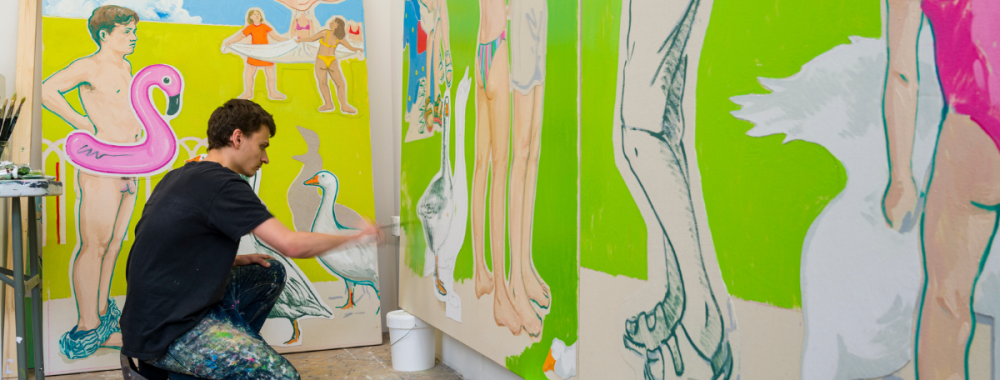
Course structure and content
The MA Fine Art combines independent studio practice with structured teaching, critical enquiry and professional development. Teaching includes individual tutorials, group critiques, seminars, lectures, workshops, presentations and study visits.
The course is organised into three 60-credit units, supporting your progression from exploratory research through the development and public presentation of a resolved body of work, followed by critical evaluation and professional development.
Unit 1: Methods
Research, experimentation and artistic enquiry
You’ll investigate new directions for your practice through experimentation, research and critical reflection. You’ll be encouraged to question existing approaches, test materials and processes, and explore the ideas and contexts that inform your work.
The emphasis is on enquiry and discovery rather than finished outcomes, helping you establish a clear direction for your postgraduate practice.
Unit 2: Practices
Developing and presenting a body of work
Building on your research and experimentation, you’ll develop a sustained and critically informed body of work through independent studio practice, tutorials and group critiques.
The unit culminates in the MA Show, where you’ll present your work in a public exhibition, developing experience in selection, installation and audience engagement.
Unit 3: Professions
Critical reflection and professional development
You’ll critically evaluate your artistic development and consider how your practice might evolve beyond the MA.
Through research, writing and professional development activities, you’ll explore the relationship between your work and its wider artistic and cultural contexts.
The unit includes an extended critical and reflective written submission and culminates in a Critical Practice Event, where you’ll present your research and reflect on your development.
Practice Web Archive
Throughout the MA, you’ll develop a Practice Web Archive: a digital record of your work, research and critical reflection.
You’ll use the archive to document experiments, record decisions, reflect on your progress and present resolved outcomes. It forms an important part of your learning and assessment, demonstrating how your practice develops across the three units.
Full-time and part-time study
You can study MA Fine Art full-time over one year or part-time over two years. Both routes combine scheduled teaching with independent studio practice and research.
Full-time study
You’ll have an allocated studio space at the Art School and are expected to commit five days a week to your MA. Scheduled teaching may take place on Mondays,
Tuesdays and Wednesdays, with Thursdays and Fridays generally dedicated to independent studio practice and research.
Part-time study
You’ll maintain your own studio base and are expected to commit three days a week to your MA, from Monday to Wednesday.
You’ll have access to the Art School’s workshops and designated working spaces on Mondays, Tuesdays and Wednesdays during term time, with scheduled teaching concentrated across two of those days:
· Part-time Year 1: Scheduled teaching on Monday and/or Tuesday, with Wednesday available for independent study.
· Part-time Year 2: Scheduled teaching on Tuesday and/or Wednesday, with Monday available for independent study.
Part-time students do not have access to the Art School’s workshops and working spaces on Thursdays or Fridays.
Attendance and engagement
Scheduled teaching varies from week to week, so you won’t necessarily have timetabled activities every day. Attendance at all scheduled teaching sessions is expected, alongside sustained independent practice and research throughout your study week.
Assessment and feedback
Assessment combines practical work, research documentation, critical reflection, written submissions and presentations, according to the requirements of each unit.
You’ll receive feedback through tutorials, group critiques and progress reviews, helping you evaluate your development and identify priorities for further work.
Your Practice Web Archive supports assessment by documenting your research, experimentation, practical development and critical reflection throughout the course.