

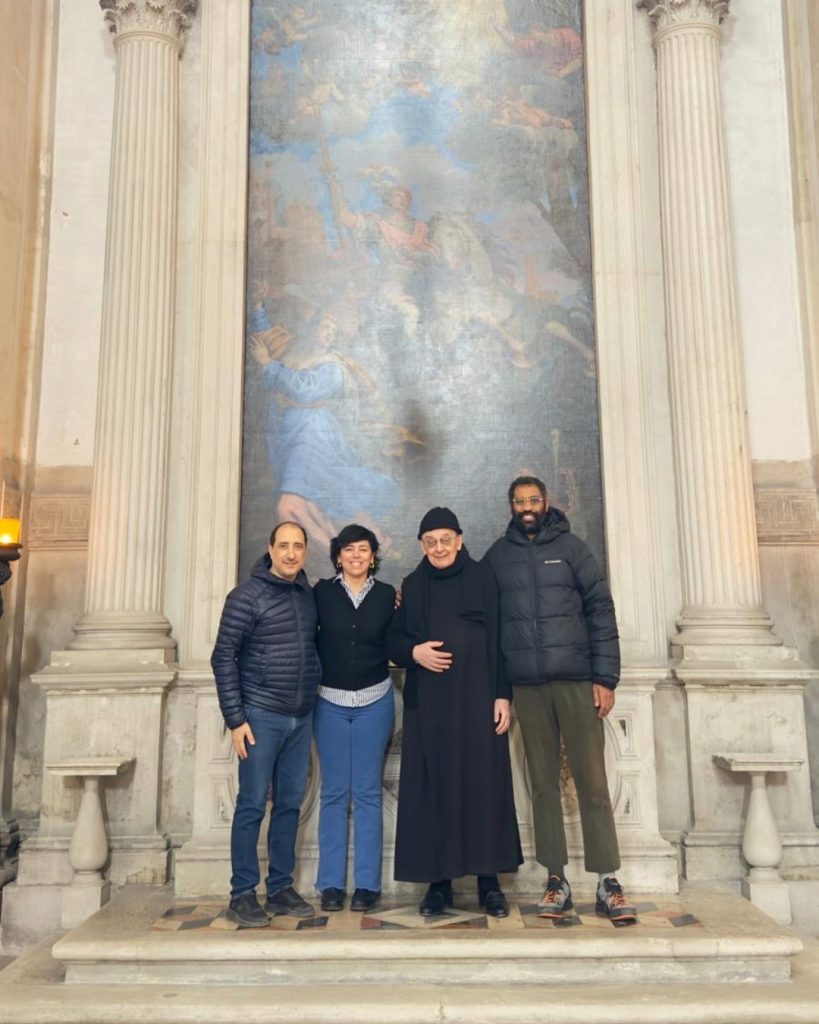
BA (Hons) Conservation: Stone, Wood and Decorative Surfaces graduates Adrian Gono and Julieta Herrera have recently spent two months on San Giorgio Maggiore, one of the islands of Venice.
Awarded at the end of year Degree Show, Adrian and Julieta were selected for the annual ‘Venice in Peril Internship‘, a two-month, fully-funded internship, living and working at the Abbey of San Giorgio Maggiore.
This initiative is supported by Venice in Peril Fund, a fund dedicated to conserving Venice’s architectural heritage and treasures in partnership with Benedicti Claustra Onlus, a non-profit arm of the Benedictine Community.
Read Adrian and Julieta’s accounts of their time in Venice below.
Adrians’s experience:
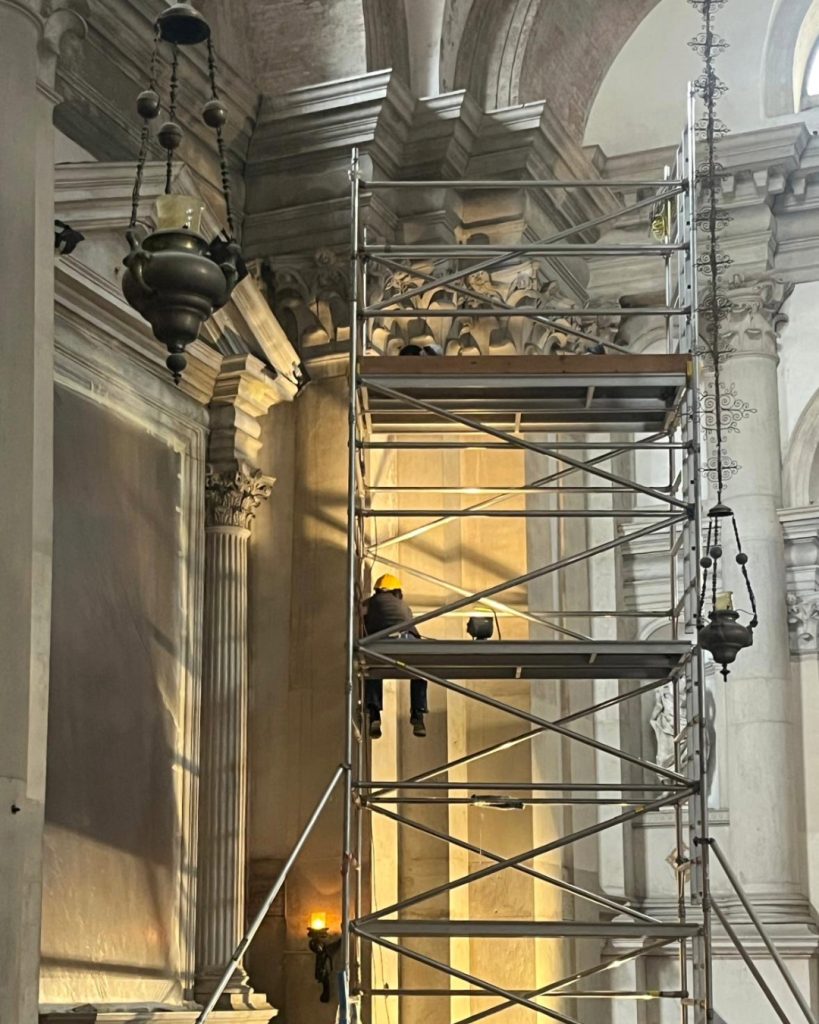
“My time at San Giorgio Maggiore was immediately engaging. From the outset, the work was detailed and purposeful. Working alongside fellow intern Julieta Herrera, over the course of ten weeks we carried out a thorough condition report of the altar, carefully identifying and documenting minor cracks, small structural failures, and areas of concern. Each finding was written up and presented to the management at San Giorgio Maggiore, in particular Carmelo, ensuring that the institution had a clear and lasting record of the altar’s condition. There was something deeply satisfying about that process: the knowledge that the documentation we produced would continue to serve the building long after we had left.
Following the condition survey, it was decided that a series of targeted treatments would be undertaken. The cleaning and dusting alone took almost two weeks, carried out on an elevated platform. Working at height, methodically moving across the surface of the altarpiece, demanded both patience and precision.
After the cleaning phase, we turned our attention to fills and consolidation of larger cracks. One of the most significant discoveries came during the inspection process: the armatures at the top of the pediment of the altar had suffered heavy oxidisation over many years and required serious consolidation. This brought us the privilege of consulting with a conservation practitioner based in Venice, whose expertise guided our decisions and treatments. We applied anti-oxidisation, oil-based protectors to seal the armatures from further contact with the air, and carried out consolidation work around the most damaged areas. Collaborating with an experienced local conservator was invaluable, it offered a perspective and depth of knowledge that extended well beyond what formal training alone can provide.
Among the most memorable moments of the project was the work on the cartouche at the centre of the pediment. A pin that had been holding it in place had oxidised and broken away entirely. Working alongside the conservator, we were able to reattach a new pin and rehang the cartouche, a delicate and precise task that required careful coordination. The cartouche itself was also cleaned, consolidated, and treated for minor tenting of its painted surface: being made of wood, the paint had dried and become flaky over time, so moisture was carefully reintroduced and the tenting flattened. During the cleaning process, a large fragment of the altar was also discovered tucked into a crevice, one that could be successfully reattached, contributing meaningfully to the overall aesthetic of the altarpiece.
The cumulative effect of all these minor treatments together was striking. The altar was left in a visibly better condition than when we had arrived, which was exactly what we hoped to achieve. It was a deeply satisfying feeling, knowing that the work had made a tangible difference to something of such significance.
Beyond the conservation itself, my time within the broader San Giorgio Maggiore community was a privilege. The staff and team members were consistently accommodating, generous, and welcoming, creating an atmosphere that made the experience genuinely rewarding on a human level.
I am enormously grateful to have had this opportunity. I know it will stay with me, both as a conservator and as a person for a very long time.” Adrian Gono
Julieta’s experience:
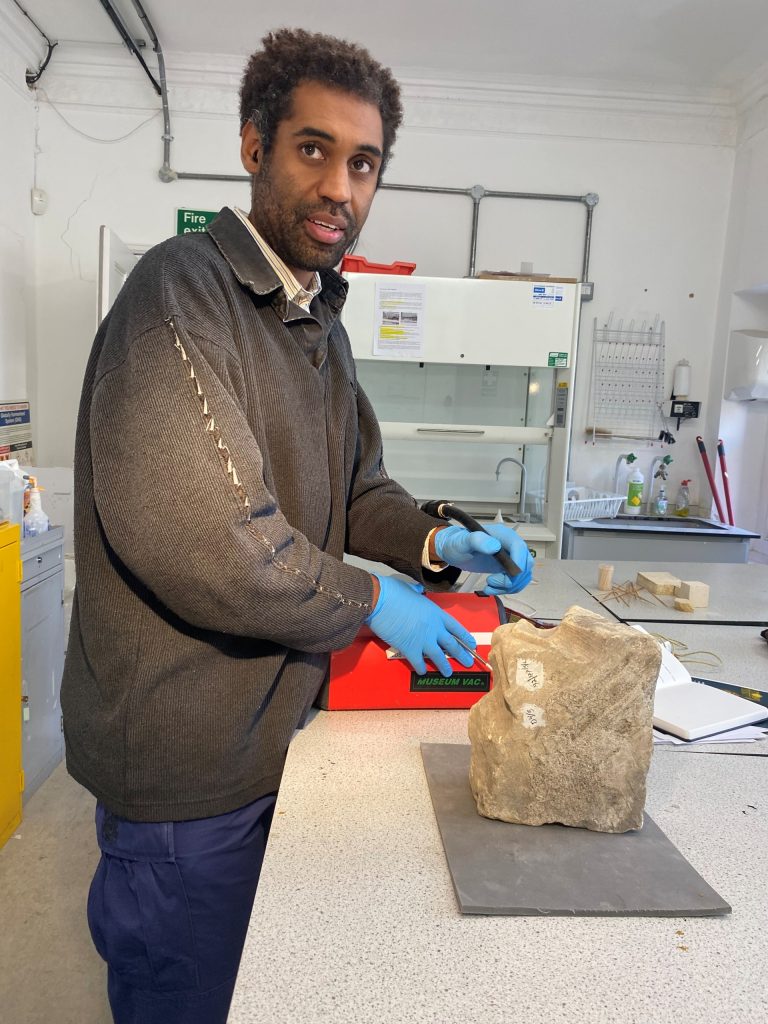
“Since my first visit to Venice with CGLAS during the second year of the course, I knew I wanted to undertake the Venice in Peril internship at San Giorgio Maggiore. I was incredibly fortunate to be able to do it a year after graduating.
Spending ten weeks working in a Palladian church was an extraordinary privilege. Being in such a significant architectural setting every day shaped the way I approached the conservation work. It was a unique opportunity to engage closely with the altar of San Giorgio, which was the main project I worked on. I also had the opportunity to visit the Cini Foundation Library to research the materials and the history of this specific altar, which houses Saint George Killing the Dragon by Matteo Ponzone.
The internship also allowed me to deepen and broaden my knowledge of conservation treatments in a practical way. Working on the San Giorgio Altar required careful observation, decision-making, and the application of methods I had learned during my training, while also adapting to new challenges. This hands-on experience gave me greater confidence, improved my technical skills, and helped me to better understand the balance between theory and practice that is essential in conservation.
Becoming part of the Abbey’s community was one of the most special aspects of the experience. Living in the monastery meant sharing in its daily rhythm, its cultural life, and its spiritual atmosphere. The encounters, the conversations, and the sense of being welcomed created a feeling of belonging that went far beyond a professional placement.
Living in Venice itself was equally inspiring. Having the time to observe the city beyond its most visited places and to walk through it every day gave me a much deeper understanding of its character. Venice became part of my daily life rather than a destination, and this changed my perception of it completely.
Travelling to nearby cities in the Veneto further enriched the experience. Visiting places such as Vicenza, Padua, and Verona helped me to see the broader artistic and architectural context to which San Giorgio Maggiore belongs. In Vicenza, I visited museums dedicated to Andrea Palladio as well as Villa “La Rotonda”, designed by the same architect whom I deeply admire.
This internship was far more than a professional placement. It was a period of intense learning, personal growth, and inspiration that confirmed my commitment to conservation and to the values that sustain it: care, patience, collaboration, and respect for the past. It is an experience that will remain with me and continue to shape my path in the years to come.” Julieta Herrera
Words and Images credit: Adrian Gono and Julieta Herrera